
Overview
For its first AI feature, a large health plan focused on a clear burden: care teams were spending too much time preparing for in-person visits because member information was scattered across systems.
We worked with the team to turn that fragmented workflow into a clearer, more connected experience. The goal was practical: help care teams review member context faster while keeping clinical judgment, accountability, and trust at the center.
UX research helped define where preparation slowed down, what teams needed in order to trust AI-supported summaries, and how success should be measured. Those insights shaped a human-in-the-loop summary tool designed to make preparation faster and easier to adopt in a high-stakes care workflow.
Background
A large health plan with care management teams supporting member outreach, assessments and in-person visits faced a familiar operational challenge: member information was fragmented across systems, making preparation for each interaction more time-consuming than it needed to be.
AI offered a clear opportunity to reduce that burden. A well-designed summary tool could help care teams review member context faster and focus more on delivering care.
But in clinical workflows, efficiency is only one part of the equation. The teams using the tool work in a high-stakes environment where accurate information, sound judgment and accountable documentation matter. If AI appeared to take control away from clinicians while leaving them responsible for the outcome, the tool could quickly lose trust. And the fact that no one system had ever provided a full picture meant we were starting our effort with a trust deficit.
For the health plan, that created a business risk. An AI feature that care teams did not trust, adopt or use in daily work would become another avoidable cost rather than a source of operational value.
As we shaped the AI-enabled solution, we embedded UX research from the start. The goal was not only to validate whether AI could help, but to understand what care teams would need in order to trust it, use it and fit it into the way they already work.
Challenges and solutions
For the client, this was their first AI feature and it was being developed under the pressure of value-based care and a shifting managed care landscape. The opportunity was clear, but so was the risk: the tool had to serve a clinician workforce whose willingness to adopt AI could not be assumed.
Challenge 1: Finding the right workflow for AI
The client had already identified in-person visit preparation as a costly workflow and saw AI as a possible way to reduce the burden. But before development moved deeper, the team needed to understand whether prep was the right focus and what made the workflow so inefficient.
Our UX research work confirmed that preparation was not a simple review task. Care management teams were piecing together critical member context from fragmented records across multiple systems before each outreach or visit.
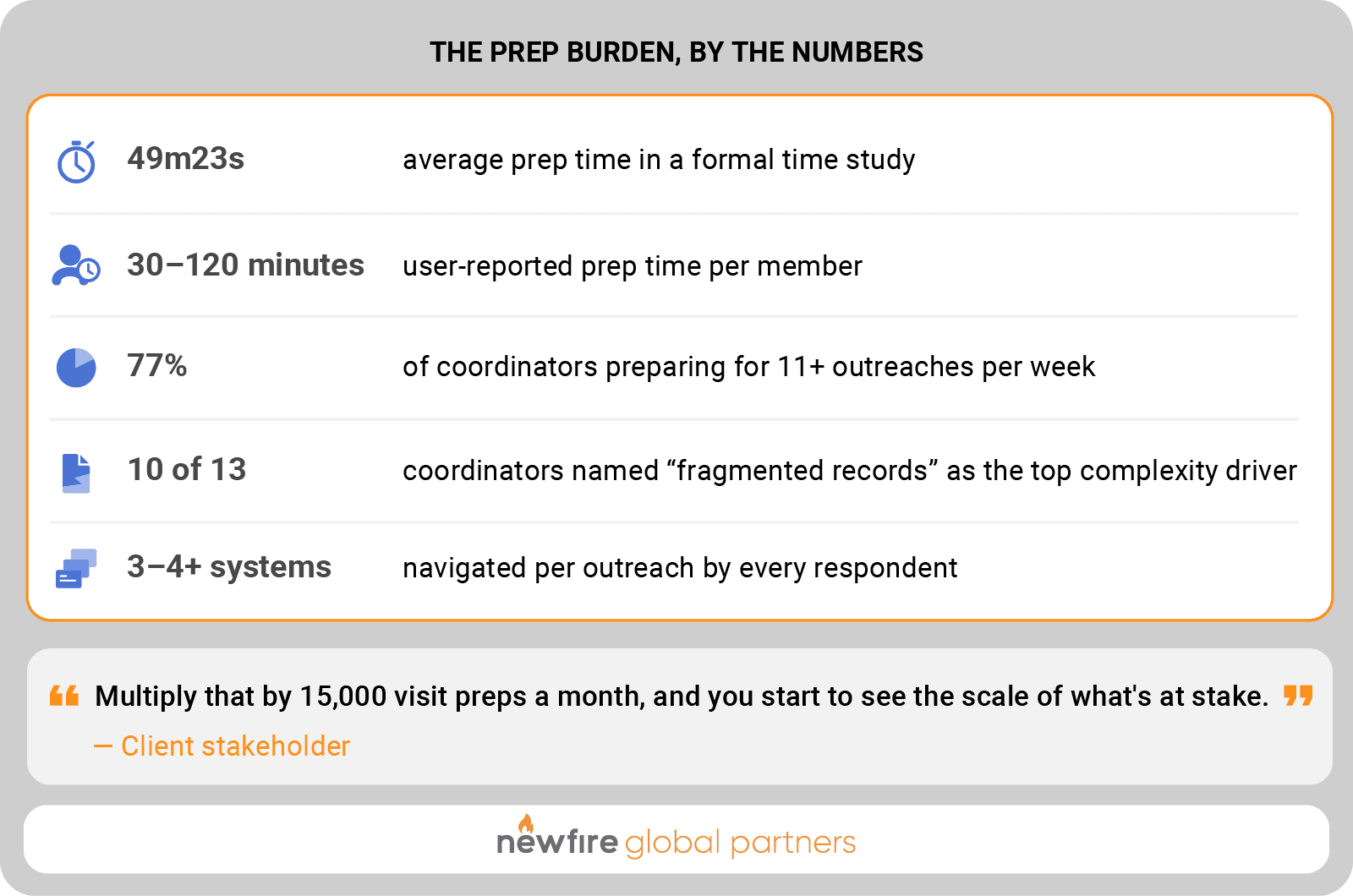
That discovery gave the team a measurable product target: reduce preparation time by approximately 20 minutes, or 40%, per case.
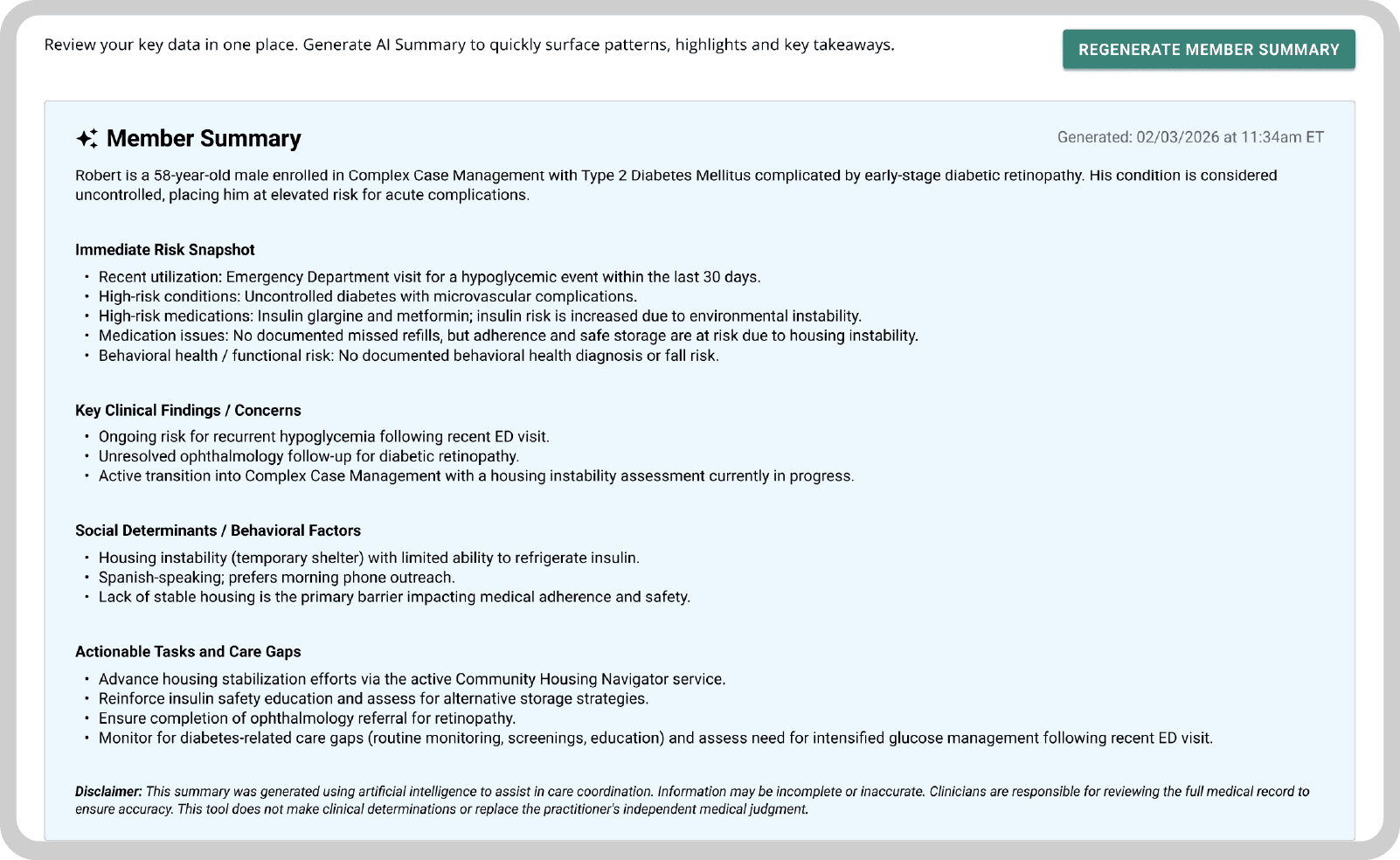
The resulting product direction was a structured, AI-powered member summary: a single scannable view that brought together the key information care teams needed before outreach or in-person visits, including member context, recent activity, critical dates, authorizations, follow-up needs and other high-priority details that were previously scattered across systems.
Challenge 2: Turning AI interest into trust
The desired outcome of the project was not simply to build an AI tool, but rather to build an AI tool care teams would adopt and use consistently enough to support the product goal. To get there, the team needed to understand how the intended users felt about bringing AI into their daily workflows.
To solve this challenge, our UX researcher used a mixed-method approach, combining interviews, surveys and existing research to assess AI attitudes and surface potential barriers to adoption.
The findings revealed that skepticism did not equal rejection. Users were already familiar with AI and open to using it at work, but their trust was conditional. In this context, trust was not a matter of preference. Care teams remained accountable for the information they submitted, and some clinicians had their professional licenses tied to the accuracy of those forms and records. AI had to be reviewable, verifiable and clearly under human control.
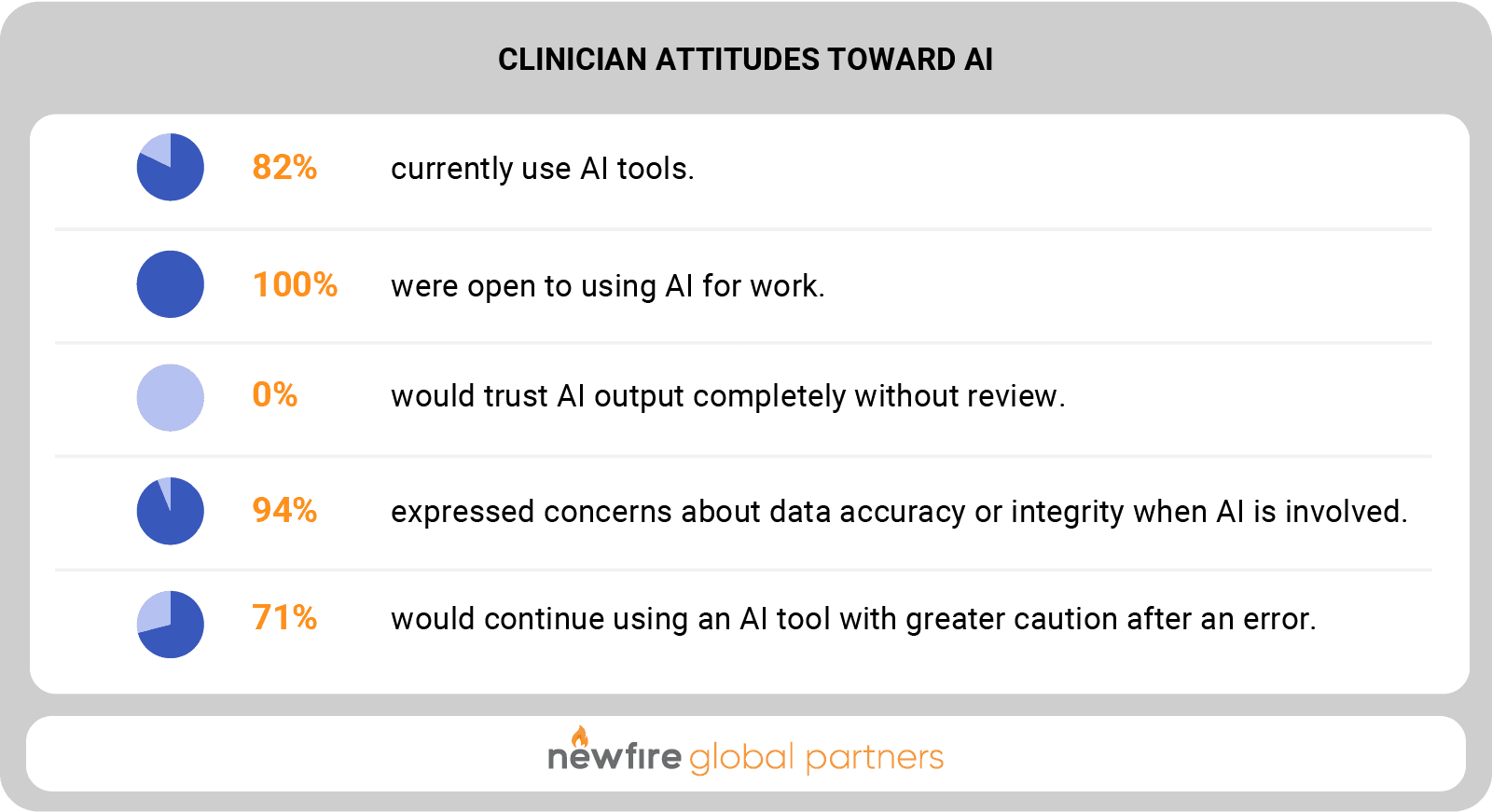
The most important finding was that zero respondents said they would trust AI completely. For product development, that became a north star. Human-in-the-loop design had to be central to the product direction.
Qualitative research added another layer. Over 480 minutes of in-person interviews with a cross-section of roles, including frontline staff, managers, clinical leaders, and experienced coordinators, two user attitudes emerged clearly. These archetypes pointed to the need for a flexible tool that could meet users where they were in their level of comfort with AI at work.
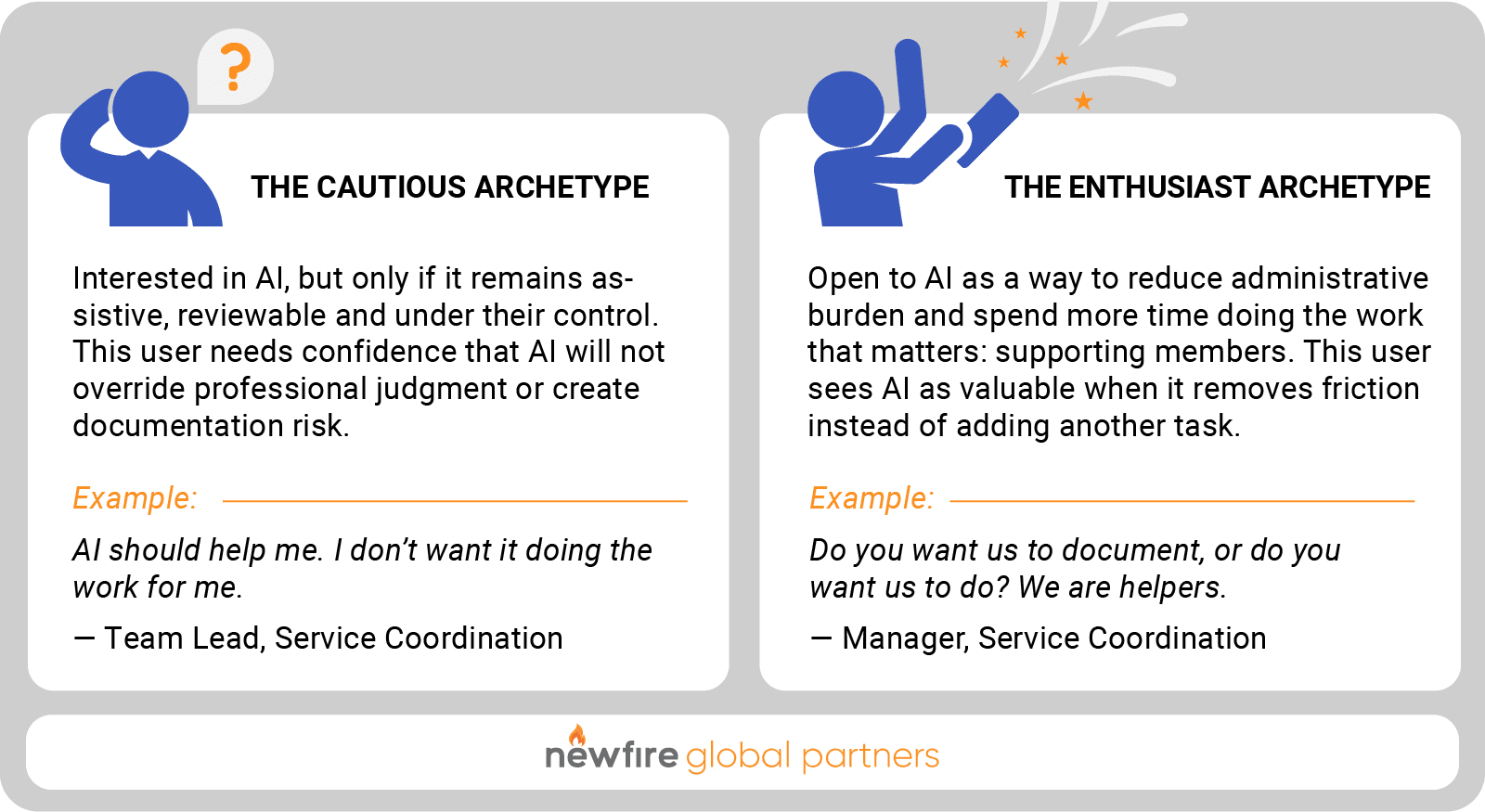
The research validated that AI could address the right problem, but only if the product gave users control over how they engaged with it.
Challenge 3: Building adoption into the product roadmap
Once the research clarified how care teams viewed AI, the next challenge was translating those trust requirements into product decisions. Adoption could not be treated as a post-launch training issue. It needed to be built into the workflow itself.
Our UX researcher, UX designer and the client’s product leads worked collaboratively to turn user feedback into requirements for an AI experience that would feel assistive, reviewable and controlled by the care team.
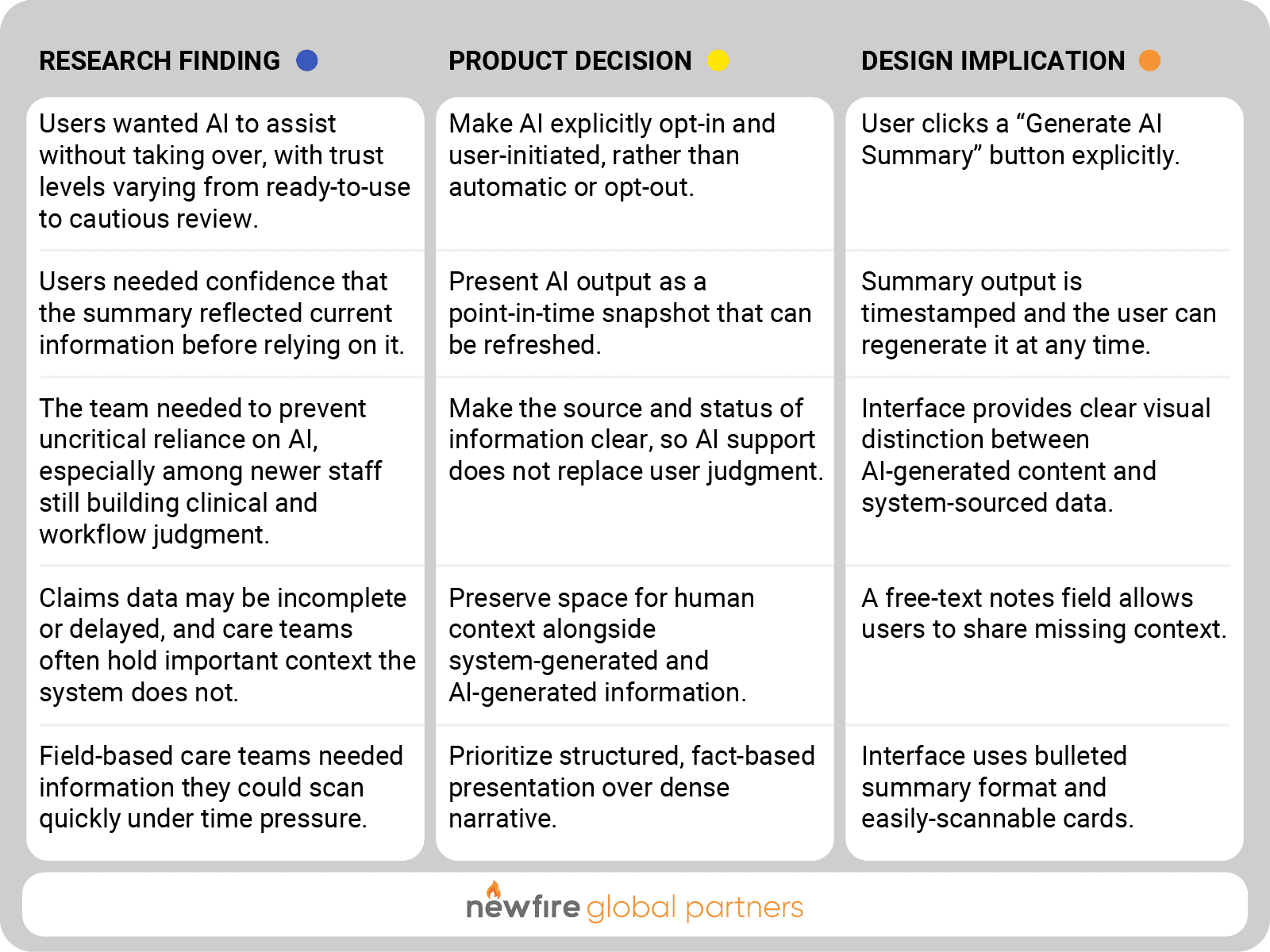
These decisions shaped the AI summary tool as a controlled, human-in-the-loop workflow that allowed cautious users to opt in at their own pace while giving more ready users a faster way to prepare for member interactions.
The Business Impact
UX research de-risked the client’s first AI feature. It showed the team where AI could help, where trust could break and what success needed to look like before the client invested further.
De-risked the first AI investment
Research confirmed that the AI summary concept addressed a real workflow need, while making adoption risks visible early enough to influence product direction.

In this kind of workflow, the stakes are high because one negative experience can change user behavior permanently. We had seen cases where automation introduced an error, and a service coordinator went back to entering everything manually, adding more than 20 minutes per visit. That is why trust and human control had to be designed into the product from the start.
Colleen, Staff UX Researcher at Newfire Global Partners
By surfacing those risks before rollout, research reduced the likelihood of a costly pivot and gave the team a clearer path forward.
Defined what success should look like
Leadership already had a clear reason to pursue the tool. Research helped make that ambition measurable by shaping a realistic product KPI: a 40% reduction in prep time.
At the client’s scale, that mattered. Based on 15,000 visit preparations per month, even a 20-minute reduction per case represented millions of dollars in projected annual savings.
Accelerated MVP direction with evidence
Research did not slow the build. Because it was embedded into product development, findings moved quickly from interviews into design decisions. The team was already iterating before the formal readout was delivered.
In roughly four weeks, the team moved from discovery to prototype validation, giving product leaders a clearer path toward the MVP without waiting for late-stage feedback. Early user research and rapid user validation helped the team avoid costly engineering rework later.
Continued Collaboration
As the product moved into pilot, the team continued using feedback to understand what was working, what needed refinement and where the next constraints were emerging.
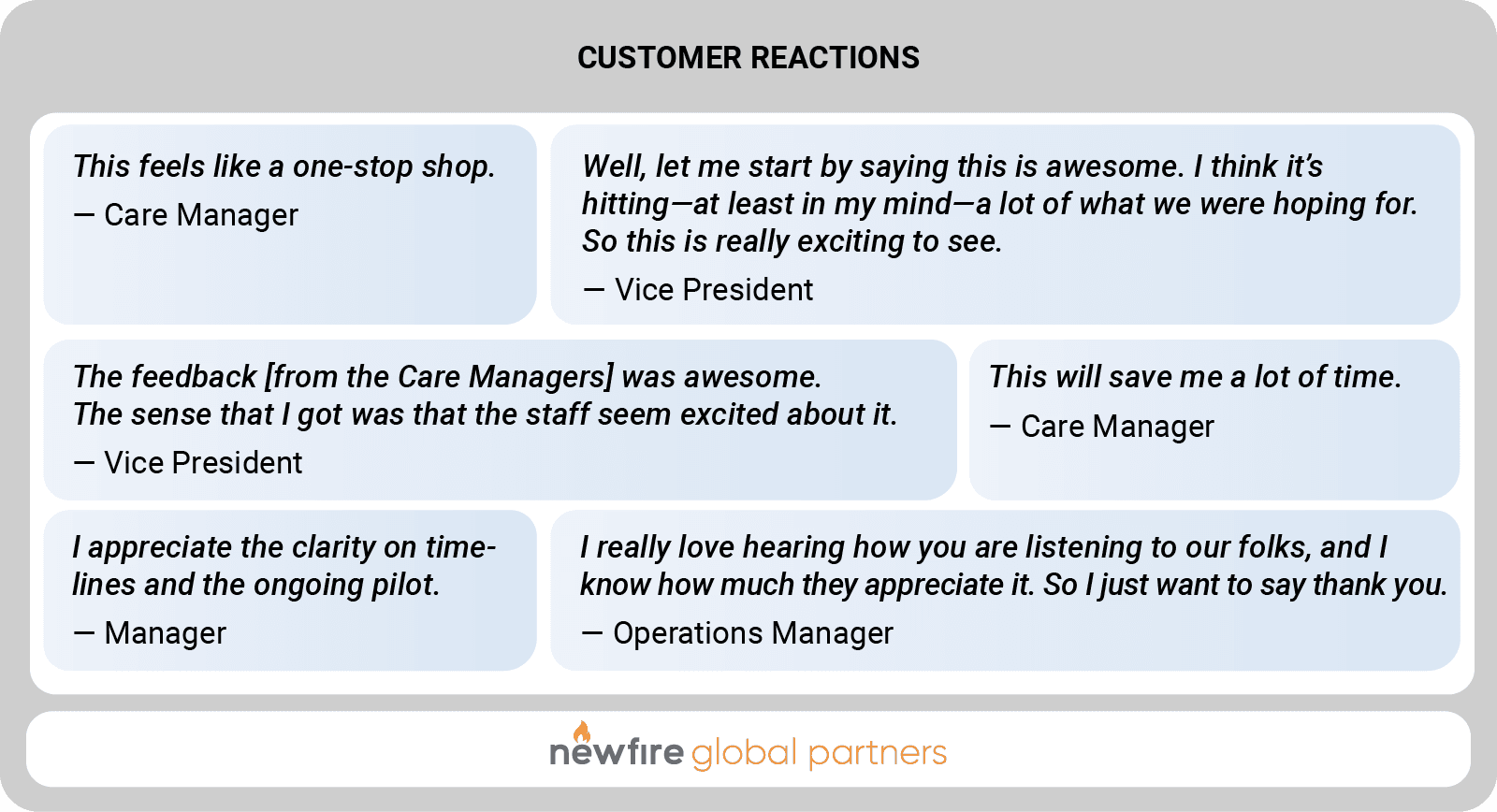
Early pilot signals suggested the product direction was sound. Participants described the summaries as well-written and accurate, indicating that the research-backed approach to workflow fit and trust was holding up in practice.
With a firmly grounded direction in place, product development continues to move forward. UX research remains part of the process, helping the team keep learning from users, refine the experience and shape the product around the realities of care management work.
Work with us
When AI enters accountable care workflows, adoption depends on more than speed. We help teams understand where trust can break, then design products clinicians can review, verify, and use with confidence. Get in touch to understand what matters most and de-risk major investments.