AI Is an Amplifier: 3 Questions to Ask Before You Invest

Most conversations about AI start with a question about tools. Which model, which platform, which copilot. That is the wrong place to start. The right question is simpler, harder, and entirely about you. This article offers one frame for thinking about AI investment, and a short rubric you can take back to your team.
The most useful way we’ve found to think about AI is not as a tool, but rather as an amplifier.
An amplifier has no opinion about the signal it receives. Whatever you feed it comes out louder. Plug AI into a strong engineering culture and it amplifies that: more good work moves through a healthy review process, and quality scales up. Plug the same AI into shaky processes and it amplifies those too, more mediocre work ships, faster. Same tool, opposite outcomes.
The determining factor was never the tool. It was what the tool got plugged into. Which means the question worth your time isn’t “Which AI tool should we buy?” It’s “What do we want to amplify, and is our foundation ready to amplify it well?”
Three questions worth sitting with
That frame is only useful if it changes what you do on Monday. So here are the three questions that we bring to any AI investment, whether that be ours or a client’s. They are easy to ask and hard to answer, and the conversations they force are usually the ones that decide whether an investment compounds or stalls.
- What signal are we amplifying? What existing capability or process is this making louder, and is it good enough to amplify?
- What bottleneck will shift, and where? When this works, what becomes the new constraint?
- Are we ready to invest in the new bottleneck? Because if we’re not, the first investment doesn’t pay off. It just relocates the problem.
The rest of this piece walks each question, grounded in work we did on ourselves.
Question 1: What signal are we amplifying?
Recently, a Newfire team ran an assessment for one of our clients that included a dozen interviews, countless pages of transcripts, and leadership waiting on clear recommendations. Rather than working through it by hand, we built two agents: a Lead Investigator that owned the whole engagement, and an Interviewer that owned the interview track.
Within hours, the nature of the work changed. We stopped writing the questions and started directing the team that wrote the questions. The job became deciding whether what they produced was good. It was less about whether the analysis was defensible, but rather deeply considering whether it was an analysis that mattered. We weren’t testing the agents like software. Instead, we were managing them like a team.
That is the quiet shift underneath the AI conversation. Every AI enabled person is becoming a manager of a team, the team just happens to be agentic. And what gets amplified is the ability to make good decisions, which matters far more than raw output.
The signal, in other words, matters more than the volume. Which is exactly the lesson of Douglas, our AI design teammate.
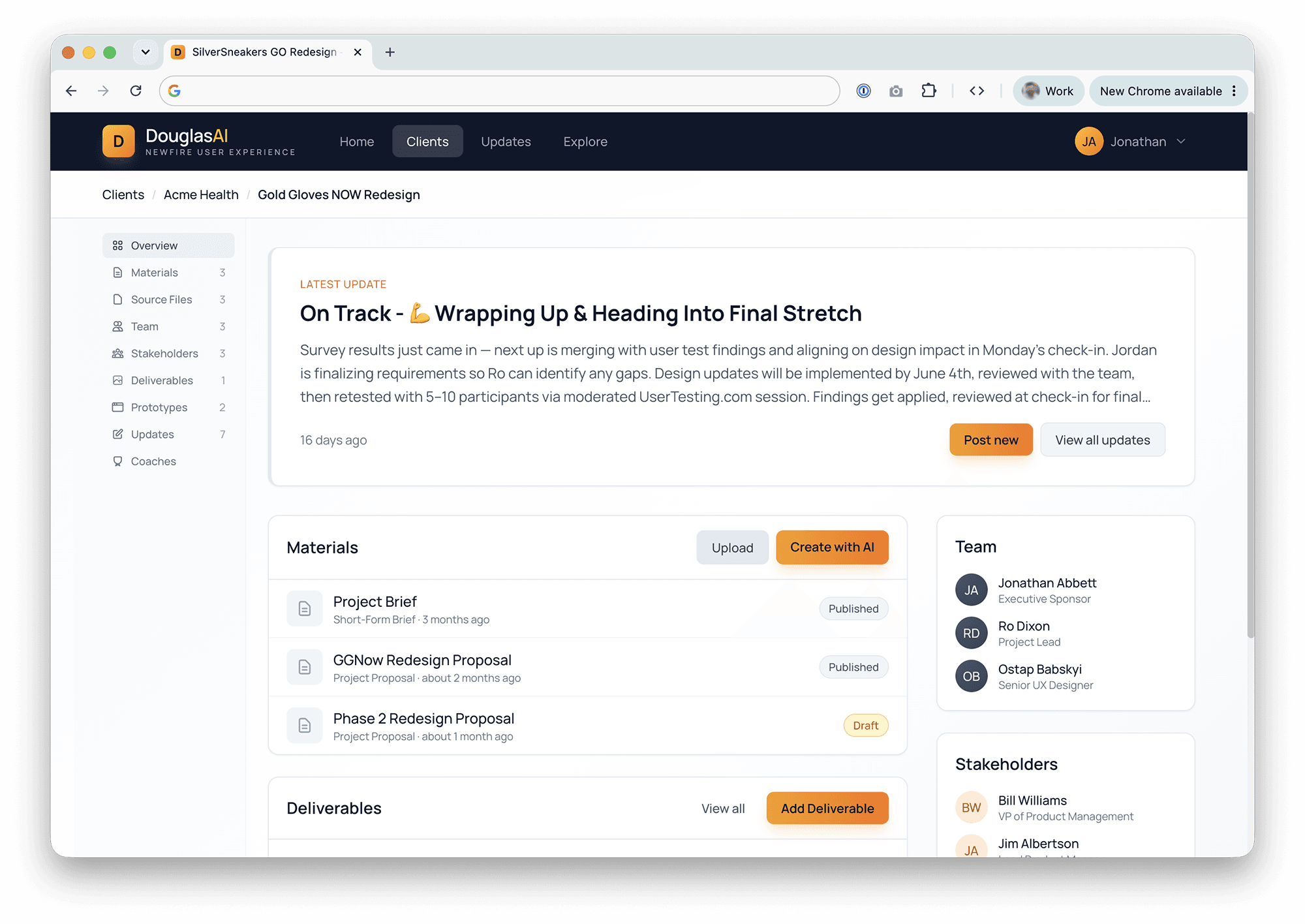
Douglas was built for our entire UX practice, not as a personal copilot for one designer. It drafts UX proposals, generates briefs, reviews work against our standards, and captures decisions in a form the team can query later. It runs on the same primitives anyone reading this could stand up: a capable model, structured prompts, codified standards.
We build tools like this for our own teams as readily as we do for clients (our engineering organization’s ExpertFinder, an AI-enabled expertise discovery platform and knowledge base, is another example). Today, Douglas writes the first draft of every UX proposal, with our real examples, the right pricing, and the relevant patterns. A senior designer reviews, edits, and ships. First drafts that used to take about two days now take about two hours.
But the speed to the deliverable is not the point. Douglas amplifies the practice behind a good proposal, rather than simply helping us write more proposals in less time. Decades of judgment about what to scope, how to price, and how to position. That is the expertise our most senior designers have built over years, and Douglas makes it operational at the level of the whole team. The operating shift is that we treat Douglas less like a tool to maintain and more like a junior designer and project manager with whom we partner.
So when you ask what signal you’re amplifying, be specific. Not “we’re using AI for proposals.” The signal is the practice. If that practice is sound, amplifying it pays off. If it isn’t, you’ll simply produce more of what wasn’t working.
Question 2: what bottleneck will shift, and where?
Make any capability dramatically faster and you don’t remove the constraint. You move it. The work piles up somewhere new, and naming where is how you know where the next investment has to go.
With Douglas, drafting stopped being the bottleneck almost immediately. The new constraint showed up somewhere we didn’t expect, namely getting an AI teammate safely into the hands of our own people. In other words, what slowed us down was operationalizing Douglas; things like deploying it, testing it, setting guardrails, and giving the team access.
We have deep experience deploying technology for clients, that is our business. Deploying an AI capability to our own internal teams was a different kind of problem, and it gave us the chance to build internal deployment and enablement muscle we hadn’t had reason to build before. Many clients are facing the same pattern. Useful AI capabilities emerging before there is a safe, repeatable way to deploy, govern and adopt them.
Solving that bottleneck unlocked Douglas and left us materially better at helping clients do the same inside their own organizations.
That is the pattern to watch for. When AI works, the constraint relocates: to code review, to judgment, to your data foundation, to how you put a capability into production. The teams that win are the ones who see the new bottleneck coming and treat reaching it as a sign of progress, not a surprise.
Question 3: Are we ready to invest in the new bottleneck?
This is the question most plans skip, and it’s the one that separates an amplifier that compounds from one that just makes the existing problem louder.
Here, the honest lesson surfaced is that you can’t amplify what you haven’t articulated. Along with our need to invest in internal deployment infrastructure, building Douglas showed us just how much of our craft lived as instinct. Years of hard-won judgment (what “good” looks like, which trade-offs to make, when to push back on a brief) had become second nature to our senior designers, the kind of expertise applied in the moment rather than spelled out.
Building Douglas was the easy part. The hard part was making that expertise explicit by translating instinct into something the whole team could operate.
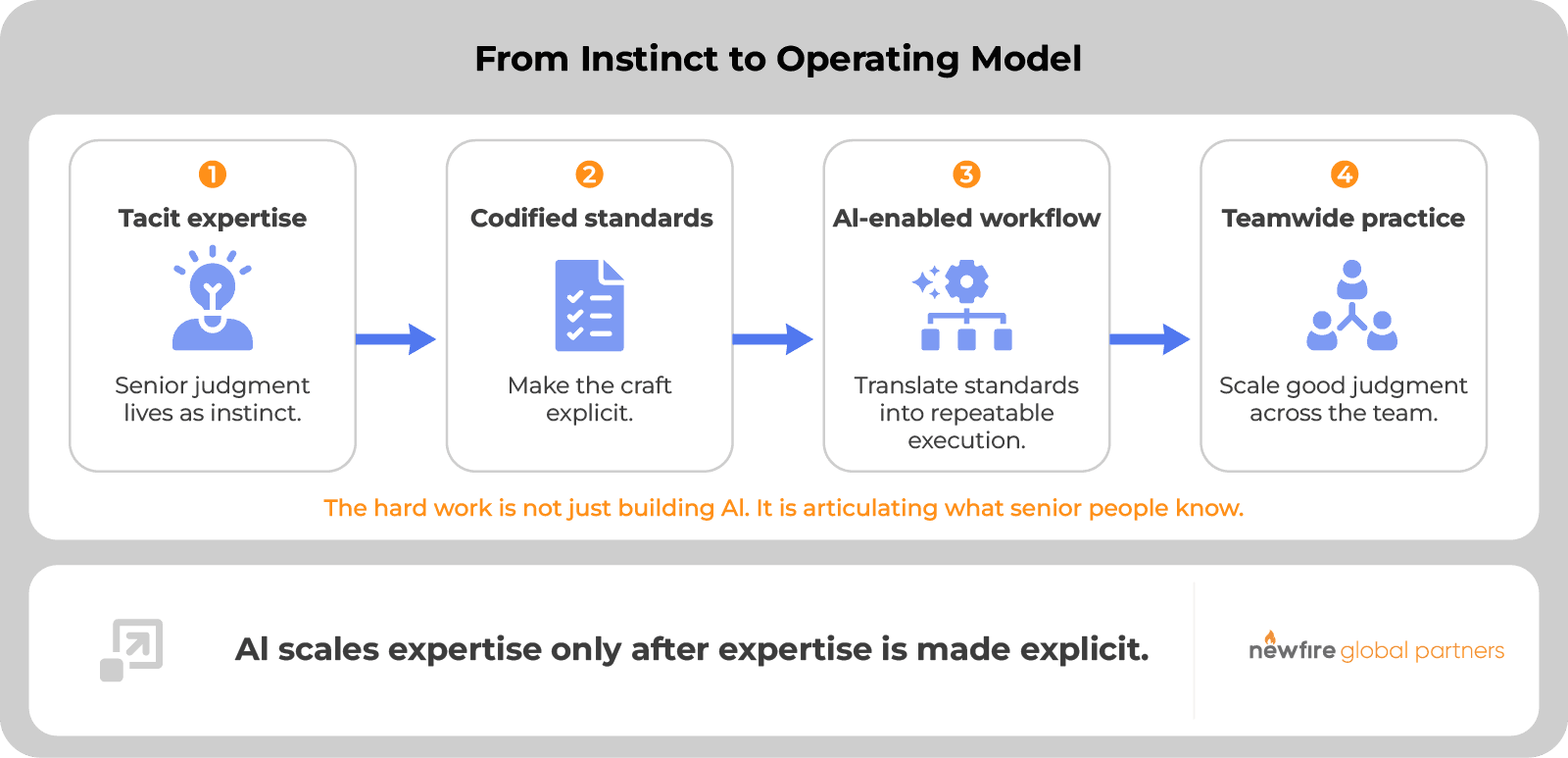
And a related truth worth saying plainly: all the AI capability in the world doesn’t help if your operating model and staffing aren’t strong enough to support delivery. Capability is rarely the thing that’s actually missing. Readiness to invest in the new bottleneck (the articulation, the people, the operating model) is what turns amplification into advantage.
Where to Start
You don’t need a strategy offsite to put this to work. Take one real AI investment you’re weighing and run it through the three questions before you write a check.
Name the signal, the actual capability or practice you’re making louder, and take time to consider whether it’s good enough to amplify. Then map the bottleneck: when this works, what becomes the new constraint, and where does the work pile up next? Finally, be honest about readiness. Are you truly prepared to invest in that new bottleneck, including the unglamorous work of articulating what your people already know but have never written down?
If the answer to the third question is no, that’s not a failure. It’s the most valuable thing the exercise can tell you, because it points at the real work before you’ve spent a dollar amplifying the wrong thing.
AI is going to make your organization more of what it already is. Rather than choosing the right tool, the work that really matters is deciding what you want to amplify, and whether your foundation can amplify it well.
At Newfire, we help teams find the right signal to amplify, whether that means strengthening our own practices, reducing operational drag, or giving clinical teams on the client side more time to focus on patients. If you’re thinking about where AI belongs in your organization, we’d welcome the conversation.
The News(fire)
Curated insights delivered monthly to your inbox.