Missteps Blog Series: The AI Shortcut Myth

Generative AI has significantly accelerated the coding process within software development. AI-powered coding assistants can now write new code, refactor existing code, and document functionality in a fraction of the time previously required.1
In a controlled study, developers using AI completed coding tasks approximately 56% faster than developers working without AI assistance.2
Developers remain responsible for evaluating technical tradeoffs, identifying errors, applying organizational context, and ensuring software satisfies business, security, and performance requirements.1
As code generation becomes increasingly commoditized, many organizations are mistaking the speed at which AI writes code for progress toward a working product.
Generative AI has increased development throughput, but higher throughput does not automatically produce stable, resilient software. Architecture and engineering judgment remain the disciplines that determine whether rapidly generated code becomes a durable product or expensive technical debt.
The Evolution of Software Development
Every generation of software development has introduced technologies and practices designed to improve speed and productivity.
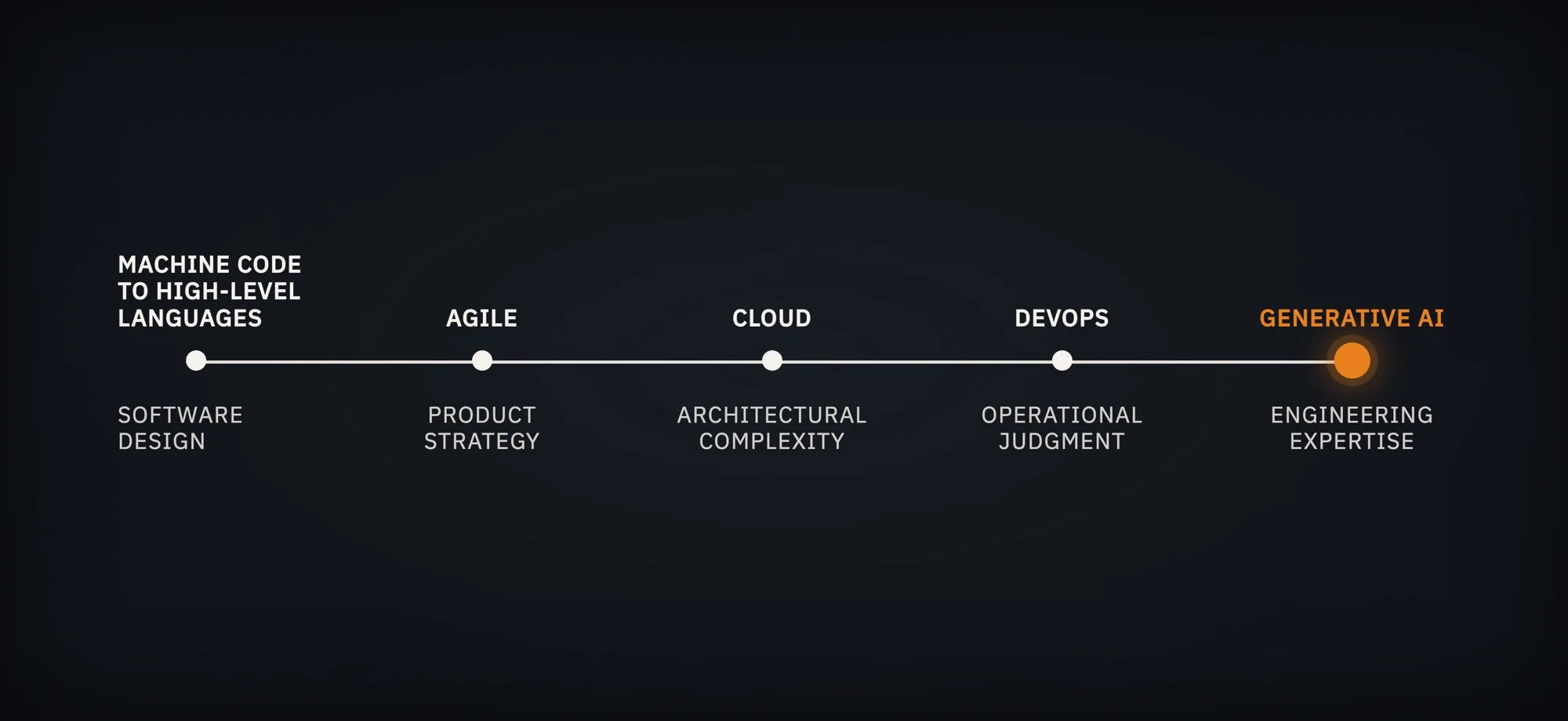
Programming languages replaced machine code, allowing developers to focus on solving business problems instead of writing hardware instructions. Agile transformed how software was delivered by emphasizing iterative development and rapid feedback.
Cloud computing removed infrastructure barriers that once slowed projects, while DevOps automated testing and operational processes to enable faster releases.
Generative AI represents the latest step in this progression. Developers can now complete many coding tasks in minutes, allowing teams to move from concept to implementation much more quickly.
Every advancement in software development has shifted, rather than eliminated, the work required to build successful products. Higher-level programming languages did not remove the need for software design. Agile did not eliminate product strategy. Cloud computing did not remove architectural complexity.
Likewise, AI does not eliminate engineering expertise. Instead, it shifts where engineering teams create value, moving it further upstream toward architecture, product strategy, and engineering governance.
AI has also changed an important dynamic within software development. Historically, increases in development throughput were expected to coincide with improvements in software stability through disciplined engineering practices.
Generative AI has significantly accelerated code generation, but increased throughput does not automatically produce stable, maintainable software.
Many organizations measure implementation speed far more readily than long-term system quality, creating a risk that architectural weaknesses remain hidden until they surface later as technical debt, operational instability, or scalability constraints.
The precise impact of AI on developer productivity continues to evolve as organizations experiment with different tools, workflows, and measurement approaches.
While early research has produced differing conclusions about the magnitude of AI’s productivity gains, that uncertainty should reinforce, rather than diminish, the importance of architectural discipline and engineering judgment.
Organizations that mistake faster code generation for faster product development risk optimizing for the metrics that are easiest to measure while overlooking the capabilities that ultimately determine business outcomes.
Architecture as the Foundation for Successful Products
Software architecture provides the blueprint for how applications, data, and infrastructure work together to meet current business needs while remaining adaptable to future change.
Strong architectural decisions create flexibility, while poor ones create constraints that become increasingly difficult to overcome.
Unlike individual pieces of code, architectural choices become significantly more expensive to change once development is underway. Organizations that prioritize short-term implementation over deliberate architectural planning often accumulate technical debt, increasing maintenance costs while slowing future delivery.

Research shows that technical debt accounts for roughly 40% of IT balance sheets, adds between 10 and 20% to the cost of many technology initiatives, and diverts a significant portion of engineering resources away from innovation toward maintaining existing systems.3
Generative AI can rapidly produce code within an established architecture, but it cannot determine whether that architecture supports long-term business objectives or whether it will remain resilient as business requirements evolve.
AI executes within the constraints it is given.
Organizations that invest in architectural expertise early are positioned to capitalize on AI-driven development while avoiding the costly technical debt that often results from prioritizing speed over thoughtful system design.
The Necessity of Engineering Judgment
Architecture establishes the technical foundation for a product, but engineering judgment determines how that foundation evolves throughout the software development lifecycle.
Engineering judgment guides the countless decisions that shape how software is designed, developed, and refined. It ensures that technical choices remain aligned with the product’s long-term direction.
AI cannot replace the experience required to evaluate tradeoffs, challenge assumptions, and determine the best path forward.
Organizations that mistake faster code generation for engineering progress often spend the following months untangling technical debt, reworking critical functionality, and addressing scalability issues that were introduced much earlier in the process.
Modern Competitive Advantage Defined
The widespread adoption of generative AI requires organizations to rethink where engineering teams create value.
Rather than assuming AI reduces the need for engineering expertise, leaders should recognize that automation shifts engineering value toward architecture and engineering governance.
Organizations that focus primarily on accelerating code generation may achieve impressive development throughput without delivering equally meaningful improvements in software quality, resilience, or business outcomes.
Recent research reinforces this challenge. Despite widespread investment in AI technologies, 74% of companies have yet to generate tangible business value from their AI initiatives.4
Those who combine AI-driven productivity with mature architectural practices, experienced engineering leadership, and effective governance will be better positioned to realize lasting competitive advantage.
AI has changed the economics of software development by making code generation faster and more accessible than ever before. However, architecture and engineering judgment continue to determine whether software delivers meaningful business value.
Organizations that succeed are defined by the strength of the architectural expertise and engineering judgment behind the AI-supported code. Competitive advantage belongs to those who strengthen the capabilities that AI cannot replace.
The News(fire)
Curated insights delivered monthly to your inbox.

