Missteps Blog Series: Endless Discovery Burns Runway

93% of senior executives aim to reinvent their business model at least every five years.¹ Simultaneously, only 50% of projects surveyed successfully reinvent their business. Executives in the Project Management Institute research study cited the disconnect between planning and execution as the single top barrier to successful transformation. Eliminating this disconnect requires organizations to maintain alignment between planning, building, and scaling technology solutions.
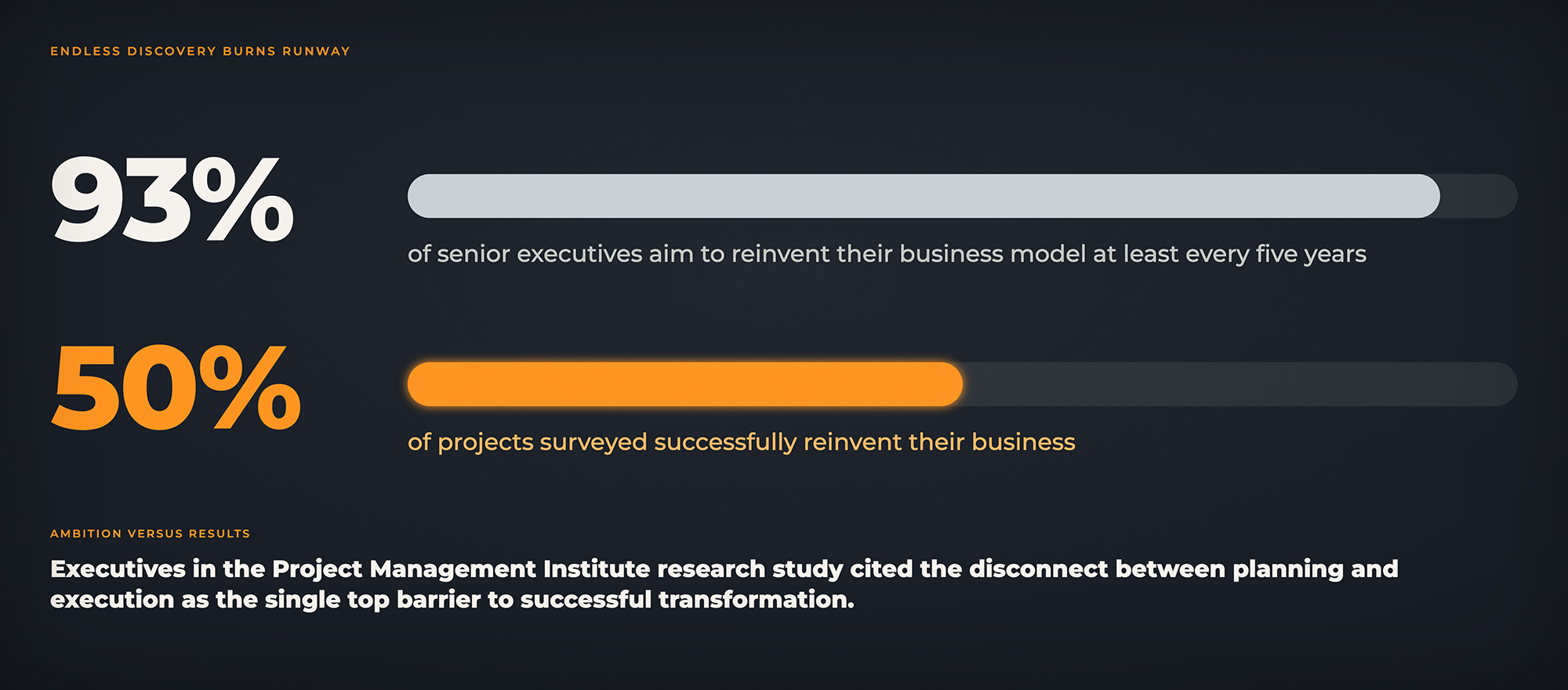
While the discovery phase is a necessary part of software development, organizations often assume that more extensive upfront planning will reduce project risk. When discovery continues without defined objectives or deadlines, teams can consume valuable time and budget without making meaningful progress toward delivery.
Reasons Behind Delayed Execution
Discovery is intended to help organizations determine what to build and why. Activities such as stakeholder interviews, requirements gathering, technical assessments, and planning workshops help teams establish a foundation for development. However, discovery can become counterproductive when organizations attempt to resolve every uncertainty before beginning development.
Several common practices contribute to prolonged discovery. Requirements expand as stakeholders introduce additional features. Discussions continue across multiple meetings without producing definitive decisions. Documentation grows increasingly extensive, delaying the transition from planning to building functional solutions. In some cases, organizations hesitate to begin development until every potential risk has been identified and addressed.
While this approach may appear cautious, it can create a cycle in which teams continuously refine plans without testing whether their assumptions hold true in practice.
Consequences of Extended Discovery
Prolonged discovery creates financial and operational risks that can undermine the objectives it was intended to protect. Every additional week spent in discovery consumes budget, reduces the remaining delivery window, and postpones opportunities to validate assumptions through working software.
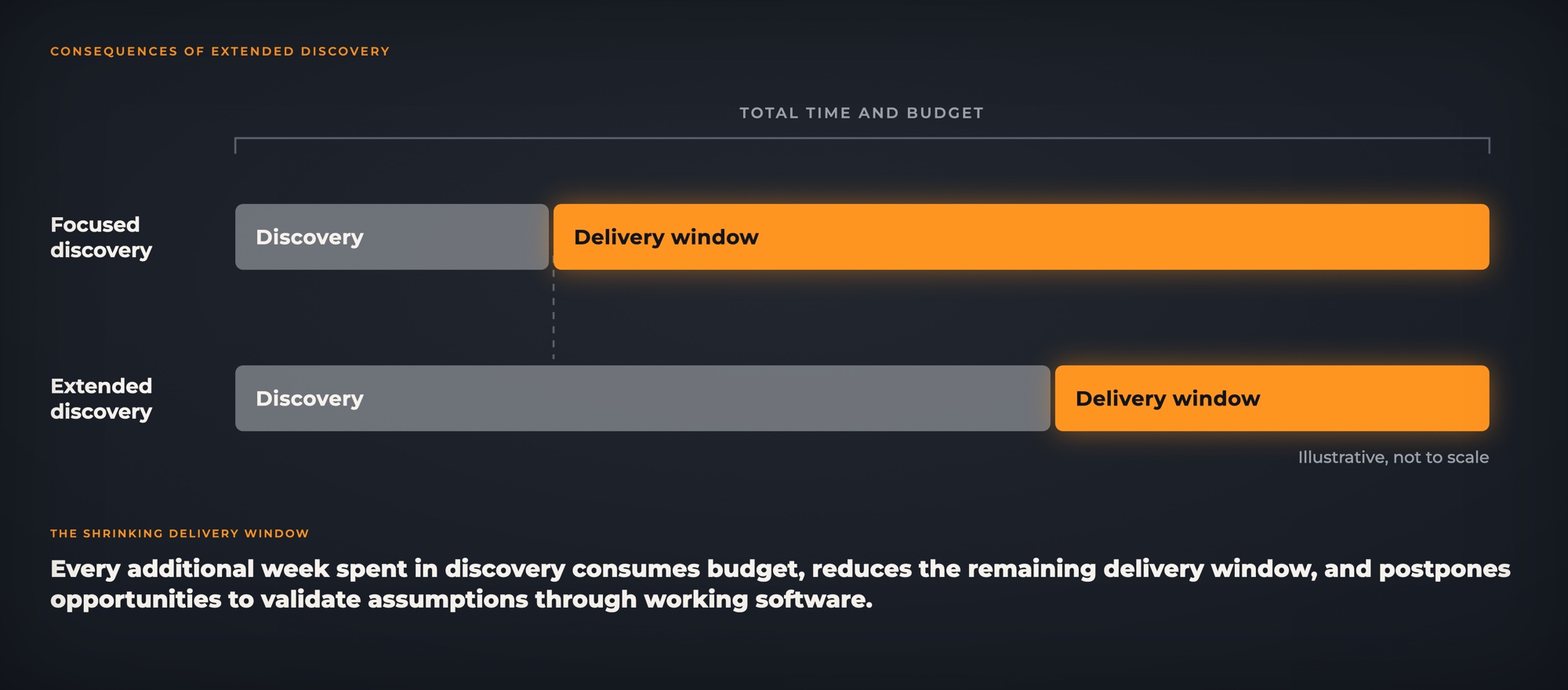
Extended planning also creates the risk that customer needs or market conditions will change before development begins. Customer expectations, business priorities, and market conditions can change while teams remain focused on planning. Requirements that appeared appropriate at the beginning of an initiative may become less relevant by the time development begins. Organizations that continue planning without transitioning to execution may ultimately have fewer resources available to develop, test, and improve their products. Rather than eliminating uncertainty, excessive discovery delays the opportunity to resolve it.
Reducing Risk Through Focused Discovery and Early Validation
Effective discovery does not require organizations to eliminate every unknown before development begins. Instead, it should establish a sufficient foundation for informed decision-making while identifying the assumptions that require further validation. Organizations can improve discovery effectiveness by adopting a more focused approach that connects planning activities to actionable outcomes through the build and scale phases.
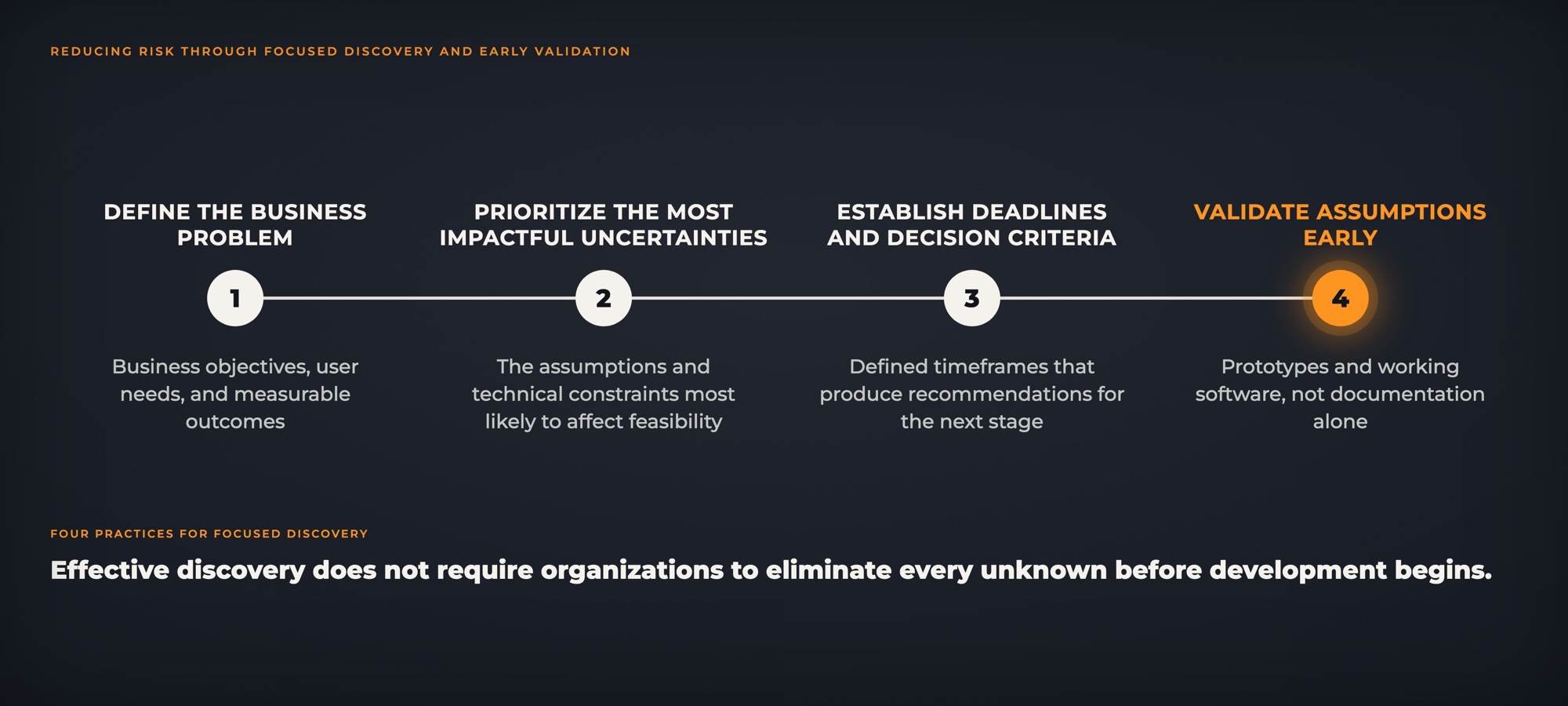
This process begins with defining the business problem. Before beginning discovery, organizations should determine the specific challenge the initiative is intended to address. This includes identifying the business objectives, understanding the needs of intended users, and defining measurable outcomes that will indicate success. An articulated problem helps teams maintain focus and evaluate whether proposed solutions support the initiative’s objectives.
Next, leaders need to prioritize the most impactful uncertainties. Not every unanswered question warrants extensive investigation before development. Teams should focus discovery efforts on the assumptions and technical constraints most likely to affect feasibility. Addressing these uncertainties first allows organizations to make informed decisions without delaying execution to resolve lower-priority concerns.
Leaders must also establish deadlines and decision criteria. Discovery should operate within defined timeframes and produce recommendations that inform the next stage of development. Deadlines help to prevent repeated discussions and unnecessary planning cycles.
Lastly, assumptions need to be validated early. Prototypes allow organizations to test proposed solutions before committing to full-scale implementation. Rather than relying exclusively on documentation and stakeholder expectations, teams can gather evidence from working software, identify potential issues, and refine their approach based on actual results.
These practices help organizations maintain the benefits of discovery without allowing planning activities to become an obstacle to delivery.
By combining clearly defined discovery objectives with iterative validation, organizations can make progress toward delivering functional solutions while continuing to refine their understanding of the problem and the most effective approach to solving it.
Turning Discovery Into Meaningful Progress
Discovery remains essential to successful software development, but its effectiveness should be measured by the actionable outcomes it produces. Organizations that mistake extensive planning for risk reduction can exhaust valuable resources before delivering meaningful results. By defining business problems, establishing deadlines, prioritizing consequential uncertainties, and validating assumptions, leaders can reduce uncertainty without sacrificing delivery momentum.
The aim of discovery is to improve the probability that execution is effective and help organizations move from planning to building and scaling solutions that deliver business value.
The News(fire)
Curated insights delivered monthly to your inbox.

