Missteps Blog Series: Delivery Speed Favors Organizational Design Over Headcount

Organizations continue to increase the pace of software engineering hires as AI increases the pace of software development.
Recent statistics show a projected 10% rise in software developer employment from 2025 to 2035.¹
Despite this continued investment, adding developers to a project does not guarantee faster delivery.
Brooks’ Law argues that adding people to a late software project often makes it later because communication and coordination complexity increase as teams grow.²
Research shows that when it comes to improving delivery speed, prioritizing IT infrastructure and automation, clearly defining roles and responsibilities, and ensuring access to supporting systems have the biggest impact.³
Strong engineers may create technical capacity, but organizations deliver products through coordinated systems of architecture, product management, engineering leadership, and execution.
Engineering headcount is often mistaken for delivery capability. When technical talent is confused for improved delivery speed, leaders eventually find that larger engineering teams do not equate to faster customer outcomes.
Linear Hypothesis of Headcount to Delivery Speed
Hiring additional engineers to increase software delivery capacity is an intuitive, albeit incorrect, assumption.
In manufacturing, adding workers to an assembly line generally increases production capacity. Some leaders naturally apply the same mental model to software.
However, software isn’t assembly-line work. Much of it requires collaboration, shared context, and in-depth decision-making.
This is easy to overlook because headcount is visible. Leaders can see how many people have been hired, how much payroll has increased, and how many teams have been created.
Delivery capability is harder to measure. It depends on whether teams have clear priorities, effective leadership, appropriate architecture, useful tooling, decision authority, and the ability to move work from an idea into customers’ hands without unnecessary friction.
A growing organization can therefore look more capable on paper while becoming slower in practice.
Exponential Growth of Communication Complexity
The problem compounds as teams grow.
Conway’s Law observes how the systems that organizations design tend to reflect the communication structures of the organizations themselves.⁴
How teams are organized, and how they interact, eventually finds its way into the technology.
Brooks identified another side of the same problem; as people are added to software teams, headcount increases linearly, while the number of potential communication pathways grows at a much faster rate.²
Every new engineer brings additional capacity, but also additional relationships to coordinate, decisions to communicate, dependencies to manage, and context to share.
Without the right operating model, that coordination begins to consume the capacity the organization was trying to expand.
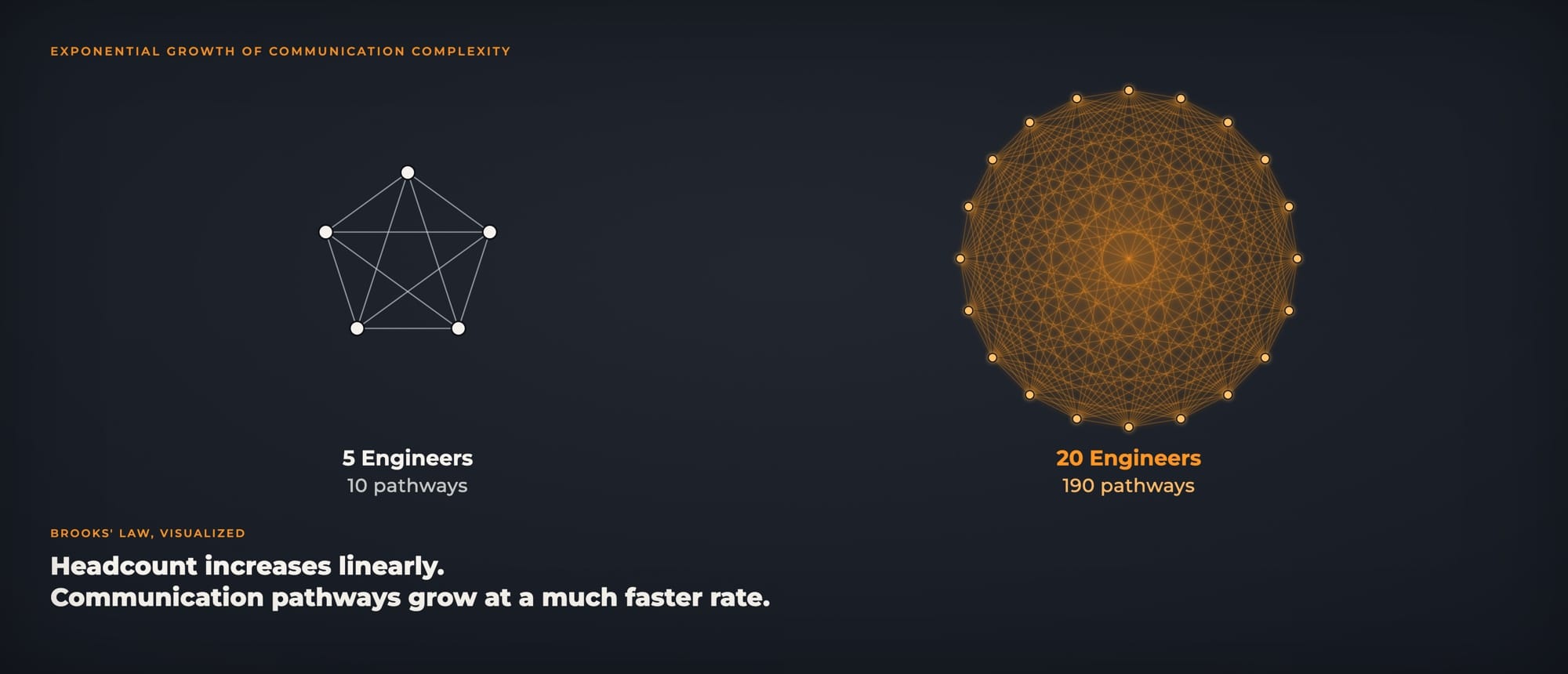
Headcount increases linearly. Communication pathways grow at a much faster rate.
A feature that once required agreement among a few people may now cross multiple teams.
Architecture decisions require more stakeholders. Dependencies multiply. Meetings appear to manage the dependencies.
Engineers spend more time understanding who owns what, waiting for decisions, resolving integration issues, and bringing new team members up to speed.
The organization responds to slow delivery by hiring. The new hires enter the same system that made delivery slow in the first place.
Predictably, the result is rising engineering costs and unchanged customer delivery speed.
Organizational Design Made Essential By AI Utilization
Embedded AI functionality is commonplace throughout software development organizations.
While AI improves code generation, variables such as architecture, product priorities, system dependencies, and tradeoffs require context and human judgment.
Increased coding speed creates limited value if teams are dealing with unnecessary handoffs or building toward the wrong customer need.
Simultaneously, engineers operating within an organizational design optimized for work coordination may see an improvement in delivery performance.
Organizational operating models determine whether engineering capacity leads to better customer outcomes.
Effectively Improving Delivery Speed
Research into digital delivery suggests that speed depends on more than staffing.
In an analysis of more than 1,700 teams, four organizational capabilities were identified as having a statistically significant relationship to delivery speed: IT infrastructure and operations, defined roles and responsibilities, supporting systems and tools, and a strong focus on the customer.⁵
Notably, simply increasing team size was not among the primary drivers.
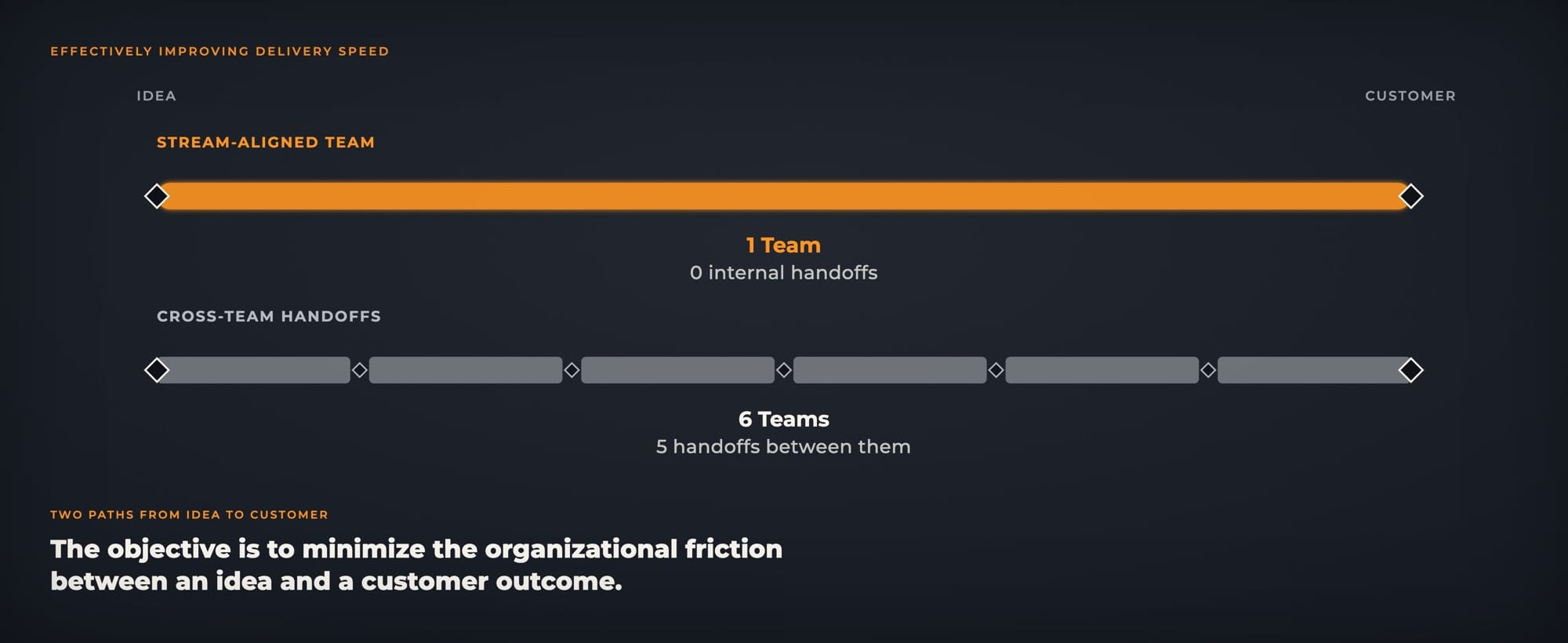
The objective is to minimize the organizational friction between an idea and a customer outcome.
Additional research points in the same direction. An analysis of more than 600 technology projects found that teams of roughly 10 to 15 people achieved the strongest overall balance of schedule adherence and quality.⁶
The implication is that organizations should optimize for the efficient flow of work rather than the size of the engineering organization.
This can be accomplished by creating small, stream-aligned teams that own a business capability end-to-end, minimizing handoffs between teams, and intentionally designing how teams interact.⁷
The objective is to minimize the organizational friction between an idea and a customer outcome.
Hiring talented engineers remains important to product quality. However, organizations increase delivery of said products when they prioritize operating models that enable technical talent to execute effectively.
Leaders need to distinguish between staffing problems and organizational design problems in order to create the conditions necessary for effective delivery at scale.
The News(fire)
Curated insights delivered monthly to your inbox.

